- What is the mission of the BCRP?
- What are the functions of the BCRP?
- What does the BCRP independence consist of?
- What is the highest authority of the BCRP?
- What is the BCRP inflation target?
- Why did the BCRP reduce its inflation target from 2.5 percent in 2002-2006 to 2.0 percent?
- How is monetary policy designed to meet the inflation target?
- What is the interbank interest rate?
- How does the BCRP get the interbank interest rate to converge to the reference level set by the Board of Directors?
- Which window facilities are offered to financial entities by the BCRP?
- How is the interbank interest rate connected with the rates on deposits and loans?
- Should the BCRP establish controls on the interest rates on bank operations in order to reduce them?
- Does an increase in the level of liquidity necessarily bring about higher inflation?
- What type of dollarization is there in the Peruvian economy?
- Is monetary policy ineffective when the economy is highly dollarized?
- What risks does financial dollarization imply?
- What are net international reserves?
- Why are net international reserves important?
- What are reserve requirements?
- Why does the BCRP carry out foreign exchange operations?
- Why is it important to develop instruments in soles with long maturity terms?
- Do BCRP interventions in the foreign exchange market increase exchange rate volatility?
- Does foreign exchange market intervention seek to set the exchange rate?
- Has the Central Bank increased or facilitated short-term external financing?
1. What is the mission of the BCRP?
As established by the Peruvian Political Constitution of Peru, the objective of the BCRP is to preserve monetary stability. To do so, the Central Bank has established an inflation target of 2.0 percent, plus or minus 1 percent. BCRP actions are oriented to maintaining this level of inflation in the Peruvian economy.
Inflation is detrimental to economic development because it prevents money from adequately fulfilling its functions as a medium of exchange, as a unit of account, and as a store of value.
Inflation discourages investment and promotes speculation because it generates distortions in the price system, as well as an inefficient allocation of resources. The devaluation of money resulting from generalized and continuous rises in the prices of goods and services affects mainly low-income groups as these groups have usually no easy access to inflation hedging mechanisms. Thus, by maintaining inflation low, the BCRP creates the necessary conditions for normal economic activity which, in turn, contributes to achieving higher levels of sustained economic growth.
2. What are the functions of the BCRP?
The BCRP functions, as defined by the Constitution, include the following: to regulate money and credit in the financial system, manage international reserves, issue notes and coins, and periodically report on the country’ finances.
3. What does the BCRP independence consist of?
In order to fulfill its mission, the BCRP must be independent. In other words, the independence of the Central Bank is essential to ensure that monetary policy decisions are oriented to compliance with the BCRP constitutional mandate of preserving monetary stability.
The BCRP Organic Law states that the Central Bank is an autonomous public institution, and stipulates that members of the Board of Directors can only be removed due to serious wrongdoing, criminal offense, or should they:
- Finance the Public Treasury, except in the case of purchases of Public Treasury securities in the secondary market up to a limit of five percent of the previous year’s monetary base;
- Finance public development financial institutions;
- Allocate resources to establish special funds aimed at financing or promoting non-financial economic activities;
- Issue securities, bonds, or contribution certificates of mandatory acquisition;
- Impose sector or regional coefficients on the loan portfolios of financial institutions;
- Establish multiple exchange rate regimes or discriminatory treatments in foreign exchange regulations;
- Issue guarantees, bid or performance bonds, or any other kind of guarantees; use any other form of indirect financing; or provide any form of insurance.
These prohibitions provide the Central Bank with the operational independence the bank requires to carry out its monetary policy-related responsibilities. The Bank is therefore not subject to fiscal restrictions (such as financing the Public Treasury) or to any other type of restrictions that may prevent it from complying with its mission.
4. What is the highest authority of the BCRP?
The Board of Directors is the highest authority of the Central Bank. As such, the Board is not only responsible for determining the policies required to fulfill the Bank’s mission, but also for its general activities. The Board is integrated by seven members. The Executive and the Legislative Branches each appoint three members to the Board. The Chairman is designated by the Executive and ratified by the Permanent Commission of the Congress.
The Board Members do not represent any particular entity or interest, and their term in office is similar in duration to that of the President of Peru.
The Central Bank’s General Manager is in charge of both the technical and administrative operations of the BCRP.
5. What is the BCRP inflation target?
The Bank’s inflation target is to reach an annual accumulated inflation rate of 2.0 percent, plus or minus 1 percent. The BCRP is permanently monitoring that this target be met as this inflation range allows the country to have a regular economic performance, without inflationary or deflationary pressures, within a context of monetary stability similar to the one enjoyed by other countries with stable currencies.
The inflation target is continuously measured against the last-12-month Consumer Price Index (CPI) for Metropolitan Lima to evaluate if the target has been met. Should inflation deviate from the target range, the Central Bank will take any necessary action to make it return to the target range, taking into account the lags of monetary policy.
6. Why did the BCRP reduce its inflation target from 2.5 percent in 2002-2006 to 2.0 percent?
By reducing the inflation target from 2.5 to 2.0 percent, the Central Bank reinforces its commitment of preserving monetary stability as this action will allow providing the nuevo sol with a higher purchasing power in the long-term.
The reasons for adopting this new target are that:
- A lower inflation target will contribute to the de-dollarization of financial transactions and savings because the domestic currency will be more robust. In turn, this will reduce vulnerabilities associated with the financial dollarization of the economy, improving monetary policy transmission and efficiency.
- Developing the capital market and promoting savings require a sounder currency to prevent the devaluation of long-term investments. The impact of this in a longer period of time, i.e. 20 years, would mean preventing about a 10 percent loss in the value of our currency.
- The rate of inflation in the country is equated to the inflation rates guiding the monetary policies of our main trading partners, and thus the value of the nuevo sol against other currencies will not depreciate in the long term to compensate for higher inflation levels in our country. Over 60 percent of our trade is carried out with economic blocks that show inflation rates lower or equal to 2.0 percent. Moreover, this 2.0 percent inflation rate is used (explicitly or implicitly) by central banks that have been successful in keeping inflation expectations under control, such as the U.S. Federal Reserve, the European Central Bank (ECB), the Bank of Canada, the Bank of England, etc.
- The credibility generated by the BCRP in controlling inflation allows setting an inflation target of 2.0 percent.
7. How is monetary policy designed to meet the inflation target?
The announcement of a quantitative inflation target, making monetary policy decisions on a timely basis so that the inflation target may be achieved, and communicating the rationality of said decisions to the public are the core actions of the framework used by the Central Bank to preserve monetary stability.
In line with these criteria, the Central Bank has implemented Inflation Targeting since 2002. Under this scheme, an inflation target of 2.0 percent, plus or minus one percentage point, has been announced since early 2007. This target, which is calculated by the National Statistics and Information Institute, is measured as the percentage change observed in the Consumer Price Index for Metropolitan Lima. Both announcing the target and systematically meeting it contribute to anchor the public’s inflation expectations at this inflation level. Until 2006, the inflation target was 2.5 percent, plus or minus one percentage point.
In order to achieve price stability, the Central Bank seeks to prevent possible deviations of inflation vis-à-vis the target on a timely basis, given that BCRP’s monetary decisions will affect inflation only after some quarters.
Monetary policy actions consist of modifying the reference interest rate for the interbank market, just like the other central banks following this scheme do. Depending on whether inflationary or deflationary pressures are observed in the economy, the BCRP will preventively modify the reference interest rate to maintain inflation at the target level.
At the beginning of every year, the BCRP publishes the dates when the Board of the Central Bank will make monetary policy decisions usually at the first meeting of the Board every month. The Board’s agreements and decisions are then immediately announced to the public through press releases explaining the main reasons that support said decisions. These press releases are also published on the Central Bank’s web site (http://www.bcrp.gob.pe).
In order to generate credibility regarding the inflation target and contribute to anchor inflation expectations, it is important that the BCRP inform the public how it intends to meet the target, as well as the arguments explaining the Central Bank’s decisions. Therefore, in addition to the press releases, the BCRP publishes an Inflation Report every four months. This document, which is also found on the Bank’s web site, analyzes the recent evolution of inflation and the actions adopted by the Central Bank, as well as the Bank’s vision on the evolution of economic variables and on how they might influence on inflation’s future trend. Moreover, the Inflation Report also examines the main factors that could deviate inflation one way or another, which is called risk balance.
The BCRP monetary decisions are taken in a transparent manner, in line with the inflation target, taking into account the forecasts published in the Inflation Report. Therefore, the monthly press releases on the monetary program for the month are usually based on the Inflation Report or refer to it.
8. What is the interbank interest rate?
The interbank interest rate is the interest rate charged on loans between banks. These short-term operations, usually with one-day maturities, ensure that liquidity flows transitorily from banks with surpluses to banks with liquidity shortages. Given the dynamism of high-value payments in the banking system (checks clearing and other transactions), it is common for interbank markets to be relatively large.
Central banks’ monetary operations (open market operations) determine the aggregate volume of funds in the market and, therefore, the interbank rate is directly influenced by said operations. That is why many central banks, including the BCRP, use the interbank interest rate (or another short-term rate associated with it) as the operational target of their monetary policies. In these cases, central banks establish a reference level for the interbank interest rate which is consistent with the objectives of monetary policy.

9. How does the BCRP get the interbank interest rate to converge to the reference level set by the Board of Directors?
The BCRP conducts open market operations to induce the interbank interest rate’s adjustment to the level of the reference interest rate. The supply of liquid funds in the interbank market is modified through these operations, either through injecting liquidity to the banking system or through sterilizing liquidity, depending on whether the reference interest rate is subject to upward or downward pressures. Open market operations (OMO) include the following:
- Injection Operations. These operations are carried out when there is a shortage of liquidity in the interbank market in order to avoid upward pressures on the interbank interest rate that may increase it over the reference interest rate. In order to inject liquidity to the system, the Central Bank purchases securities from financial entities and provides them in this way with liquid funds. These operations are carried out through repo auctions in the financial system (temporary purchases of BCRP Certificates of Deposits or Treasury bonds, sold under repurchase agreements).
- Sterilization Operations. These operations are carried out when there is a liquidity surplus in the interbank market in order to avoid downward pressures on the interbank interest rate that might lead it to a level under the reference interest rate. To withdraw liquidity and induce a rise in the interest rate, the Central Bank auctions off BCRP Certificates of Deposits (CDBCRP) among financial entities: liquid funds are exchanged for Central Bank securities which pay an interest rate, and are thus withdrawn from the interbank market or sterilized.
10. Which window facilities are offered to financial entities by the BCRP?
Window facilities are the operations that financial entities carry out with the Central Bank when they require additional liquidity or have a liquidity surplus upon closing their daily operations,
These operations entail an opportunity cost in terms of the lending transactions produced in the interbank market. When the BCRP provides liquidity to a financial entity through window operations, the latter is charged an interest rate which is higher than the reference interest rate. Conversely, if a financial entity closes its operations with a liquidity surplus, it may deposit these liquid funds at the Central Bank with an interest rate that is lower than the reference interest rate.
Window operations include the following:
- Injection Operations. These operations are carried out when a financial entity requiring liquidity is unable to obtain it in the interbank market under the desired conditions. The BCRP may provide the financial entity with the required liquid funds through direct repo operations (temporary purchase of CDBCRP or Treasury bonds, sold under repurchase agreements), through rediscount operations, or through foreign currency swaps (temporary purchase of foreign currency, under repurchase agreements). For these operations, the BCRP charges a higher interest rate than the reference rate.
- Sterilization Operations. These operations are carried out when a financial entity having a liquidity surplus cannot place it in the interbank market under the desired conditions. The BCRP may withdraw this liquidity surplus from the system by allowing the financial entity to make an overnight deposit (one-day deposit) in the Central Bank. For these operations, the financial entity will obtain a lower interest rate from the BCRP than the reference interest rate.
Therefore, considering that:
- the Central Bank carries out open market operations with the aim of adjusting the interbank interest rate to the level of the reference rate,
- for banks, using window facilities constitutes the opportunity cost of exchanging liquidity in the interbank market, and that
- the reference rate is lower than the interest rate on injection operations, and higher than the interest rate on sterilization operations,
We can say that
Financial entities will prefer to operate in the interbank market where they may obtain or place liquidity at more convenient interest rates.
The reference interest rate for the interbank market is a rate between the interest rate on direct repo operations, the Central Bank’s rediscount facilities, and the interest rate on overnight deposits.
Both the interest rate on BCRP window operations and the reference interest rate are announced through a monthly Press Release displayed on the Bank’s website.
11. How is the interbank interest rate connected with the rates on deposits and loans?
Although the deposit and lending rates are determined by the market and not by the BCRP, the Central Bank can induce some changes in these rates because the bank is the main supplier of liquid funds. Because these funds are transacted in the interbank market, the Central Bank has more influence over the interest on operations carried out in this market. Therefore, the BCRP has a great capacity to induce changes in the interest rate on operations maturing in the shortest term (overnight).
In other markets, where less liquid and more risky assets are traded, other aspects not associated with monetary policy play a more important role in determining the interest rates. However, the Central Bank may generate gradual changes in the interest rates paid to operations with longer maturity terms by influencing the shortest-term interest rate, because the latter is used as reference to determine the former.
The Central Bank’s impact on relevant interest rates affecting public spending-related decisions will be greater if there is little “inflationary noise”. Therefore, the Inflation Targeting scheme that is currently followed by BCRP contributes to increase the impact of monetary policy through the interest rate mechanism by anchoring people’s inflation expectations at the target level.
12. Should the BCRP establish controls on the interest rates on bank operations in order to reduce them?
Experience has demonstrated that controlling the interest rates on bank operations reduces financial intermediation and favors informality because these measures affect savings and credit in the economy. In the case of credit, for example, small and medium-size businesses would only have the option of informal credit not subject to controls, which generally means significantly higher interest rates in both local and foreign currency.
Therefore, controls on interest rates prevent the market’s efficient allocation of resources between agents with surpluses (savers) and the agents requiring these resources (demanding credits). This not only discourages savings, but also has an adverse effect on the growth of economic activity.
Free competition in the financial system without interest rate controls has allowed reversing the process of financial repression, which had reduced people’s access to the financial market. Thus, credit to the private sector grew from 3 percent of GDP in the early nineties to 19 percent of GDP in 2006.
The decrease in the levels of interest rates has been paralleled by a decrease in the expected levels of inflation. However, the level of the real interest rate also depends on the country risk and on microeconomic factors such as the credit risk, the cost of nonperforming loans, and the operational costs of financial intermediation, factors which are not controlled by monetary policy.
13. Does an increase in the level of liquidity necessarily bring about higher inflation?
There is wide consensus in economic literature regarding the fact that, in the long term, money is neutral (it neither affects the output level nor other real variables) and that inflation is a monetary phenomenon. Moreover, international empirical evidence shows that there is a long-term positive correlation between an increase in the level of liquidity and the rate of inflation. However, this correlation does not imply a cause-effect relationship. Such a relationship depends on the nature of the monetary regime. When monetary policy uses the amount of money in the financial system as the operational instrument, there is a causal relationship between money and inflation. On the other hand, when the operational tool is the short term interest rate used in the money market, the supply of money is adjusted to meet people’s demand for money and, therefore, the behavior of money is less preponderant in explaining the short-term dynamics of inflation.
In the case of the Peruvian economy, when we analyze the evolution of the growth of the monetary base and currency since 2000, we see that there is no close relationship between the growth of monetary aggregates and the evolution of inflation. A possible explanation for this is that, under inflation targeting and with operational interest rates, the supply of money is adjusted to meet the demand for money. In other words, under a scheme in which the growth of the money supply is set exogenously, a deliberate increase in the money supply exceeding the demand for money with the subsequent increase in monetary aggregates would indeed generate inflation, as established by the quantity theory of money.
14. What type of dollarization is there in the Peruvian economy?
Money has three functions: it serves as a medium of payment, as a unit of account, and as a store of value. The type of dollarization observed in an economy depends on the main function ascribed to the dollar. In our economy, domestic currency is mainly used for the first two functions; that is, as a means of exchange and as a unit of account; but the third function of money, being a store of value, is mostly carried out by foreign currency (USD). Therefore, dollarization in Peru is mainly financial dollarization.
This financial dollarization is mainly the result of past situations when the domestic currency was devalued due to high and volatile inflation rates. Given the lack of financial instruments that could hedge agents from the risk of inflation, a greater preference for foreign currency as a store of value was generated.
In recent years, financial dollarization has continuously declined and reached levels similar to those observed in developed countries. Thus, the ratio of dollarization of bank obligations with the private sector has decreased from 80 percent in 2000 to less than 40 percent in recent years, favored by Inflation Targeting since this scheme involves a permanent, clear, and credible commitment with the goal of maintaining the purchasing power of the nuevo sol over time.
15. Is monetary policy ineffective when the economy is highly dollarized?
Despite the fact that the dollar has partially taken the place of the nuevo sol as a store of value, our domestic currency is used as a medium of payment and as a unit of account.
This is evidenced in the payment of salaries and in the transaction of the most important goods and services of the average consumer basket, where the domestic currency is mostly used. The dollarization of payments is therefore relatively less important in the Peruvian economy, and the local currency serves its purpose as a medium of payment. Likewise, the prices of most goods and services are expressed in soles and are not dollar-indexed.
In this way, monetary policy may be used to achieve the goal of preserving monetary stability, as has been demonstrated by the fact that the inflation target has continuously been met in recent years. Gradually recovering the use of domestic currency as a store of value will contribute to increase the effectiveness of our monetary policy.
16. What risks does financial dollarization imply?
Financial dollarization involves risks for the economy because it generates two types of mismatches in the balance of economic agents: a currency mismatch and a maturity mismatch.
A currency mismatch generates exchange risks: families and non-financial companies generally have incomes in local currency, but their debts with the financial system are mainly in foreign currency. This currency mismatch implies that a significant and unexpected depreciation of the domestic currency will considerably increase the amount of their obligations (in terms of soles), although a similar increase is not produced in terms of incomes. This is called “the balance-sheet effect”.
Additionally, when loans are made to companies or families having currency mismatches, a bank may experience losses as an indirect consequence of the depreciation of local currency, even if the bank itself does not have this mismatch: a significant depreciation causes losses in borrowers who have no protection against exchange mismatches, negatively affecting their capacity to pay their debts to the bank and thus increasing their probabilities of non-payment. In this way, banks are exposed to credit risks due to the exchange risk of debtors. Moreover, the credit risk associated with a depreciation of local currency is enhanced if the value of the loan’s collateral decreases as a result of depreciation.
A maturity mismatch, on the other hand, generates illiquidity risks. Financial entities have obligations in foreign currency (people’s deposits and debts with banks abroad), which usually have shorter maturity terms than banks’ placements. Although the maturity mismatch and the subsequent risk of illiquidity is a phenomenon inherent to banking systems, the risk is greater when liabilities are not denominated in local currency. The central bank does not issue foreign currency and therefore it cannot inject the liquidity required if it does not have adequate levels of international reserves.
Because of these risks, a financially dollarized economy is more vulnerable to abrupt exchange rate variations. Therefore, the Central Bank of Peru has implemented measures to prevent these risks. Inflation targeting is included among a first group of measures aimed at reducing financial dollarization. Not only does it contribute to “reinstate confidence” in the domestic currency, but also to develop long-term domestic currency-denominated financial instruments.
A second group of measures is geared towards promoting a more adequate capacity of response to situations of strong depreciation pressures on domestic currency, or to situations of liquidity constraints in foreign currency. These measures include a high level of international reserves in the central bank; a banking system with a high level of liquid assets in foreign currency; and a floating exchange regime that will allow to reduce abrupt exchange rate fluctuations. Furthermore, a sound fiscal position and an adequate bank supervision will also contribute to reduce the risks associated with financial dollarization.
17. What are net international reserves?
Net international reserves (NIRs) are the international liquid assets required by a country to face adverse macroeconomic shocks. They are the difference between the international liquid assets of BCRP and its short-term external liabilities. NIRs have three components:
The Central Bank’s international position, which mainly represents the counterpart to the monetary base and BCRP Certificates of Deposits (CDBCRP) balances;
Financial entities’ deposits in foreign currency at the Central Bank, formed mainly by reserve requirements in foreign currency; and public sector deposits in foreign currency.
18. Why are net international reserves important?
Increasingly growing financial globalization has brought about greater capital mobility that is not always associated with economic fundamentals (the fiscal and monetary disciplines), but in some cases rather with adverse events developing in other countries which are “passed on”. In these circumstances, the possibility of experiencing an abrupt capital outflow is always present, and liquid assets in foreign currency are therefore required to face the effects of such an outflow.
Thus, international reserves allow facing unexpected capital outflows and reducing the exchange rate volatility. In the event of capital outflows, the Central Bank uses international reserves to provide funds in foreign currency to the entities of the financial system, offsetting the effects of the liquidity crunch and preventing possible drastic reductions in credit to the private sector. Moreover, in dollarized economies, international reserves allow the central bank to act as the lender of last resort face potential withdrawals of deposits and contributes to strengthen confidence in, and the soundness of, the financial system.
In the 70s and 80s, the indicators on international liquidity emphasized a country’s potential capacity to finance imports of goods over a determined number of months (NIR-to-imports ratio). Since the 90s, however, due to increased globalization and to the integration of capital markets, the focus shifted to indicators reflecting a country’s capacity to meet its short-term financial obligations. In this way, at December 31, 2013, Peru’s net international reserves amounted to over US$ 65.66 billion, a sum equivalent to 32.5 percent of GDP, to 18.7 months of imports, to 7.9 times the country’s short-term external obligations, and to 3.5 times the balance of the monetary base. In June 2014, net international reserves amounted to US$ 64.58 billion.
19. What are reserve requirements?
Reserve requirements are the quantity of liquid assets that financial institutions must hold with the Central Reserve Bank for monetary management purposes. According to BCRP provisions, a percentage of financial entities’ obligations in both domestic and foreign currency must be held as reserve requirements, either as cash in their vaults or as current account deposits in the Central Bank.
The BCRP may change the rate of reserve requirements with the purpose of contributing to an orderly evolution of liquidity and credit, raising the rates of reserve requirements in periods of greater availability of credit expansion sources, as for example in periods of abundant capital inflows, and reducing them in periods of a slower growth of these sources. Thus, the BCRP raised the rate of reserve requirements in soles from 6 percent in February 2010 to 20 percent in April 2013 in a context of persistent capital inflows generated by quantitative easing policies implemented by the central banks of developed economies. By preventively reducing the rate of required reserves from 20 percent to 11.0 percent between June 2013 and September 2014, the BCRP was able to release funds for a total of S/. 9.5 billion since June 2013 and contribute to maintaining an adequate level of funding in soles in the banking system, supporting at the same time the process of de-dollarization of credit in a context of slower growth of deposits in soles.
The BCRP sets a rate of reserve requirements on liabilities in foreign currency with a prudential purpose since the Central Bank cannot issue foreign currency, whereas it can issue money in domestic currency. That is why the rates of reserve requirements in foreign currency are higher than the rates in domestic currency. At present, the marginal rate applicable to obligations subject to reserve requirements is 50 percent and the cap on the average rate is 45 percent. Thus, the BCRP considers that it is prudent to require banks to have a greater volume of liquid assets in foreign currency which may allow it to support the financial system in the event of situations of illiquidity in this currency. The rates of reserve requirements also increase during periods of abundant capital inflows and are lowered during periods of capital outflows, as during the international financial crisis.
Additionally, since March 2013 the BCRP has also established that the base rate in foreign currency (legal required reserves on the mean daily total obligations subject to reserve requirements in September 2013) may be raised, depending on the growth of the balance of mortgage and car loans. This measure applies if the mortgage and car loans granted by a bank grow by more than 1.1 times their respective balances in February 28, 2013, or by 20 percent of the effective equity of the bank at December 2012, whichever amount is higher. Increases in the base rate have also been established conditional to the growth of bank total loans in foreign currency (excluding loans for foreign trade operations); that is, when these loans are higher than 1.05 times the balance of these credits at September 30, 2013, and when these loans are higher than the amount equivalent to a bank’s equity at December 2012, whichever amount is higher. The aim of these additional reserve requirements is that banks incorporate the aforementioned risks of financial intermediation in dollars in the cost of credit in foreign currency.
How is the rate of reserve requirements in foreign currency calculated?
The rate of reserve requirements is calculated on a monthly basis. The funds that financial institutions must keep as reserve requirements in a month are called legal reserves. In order to calculate the rate of legal reserves, the monetary authority must first determine the obligations of a bank which are subject to this requirement; i.e. total obligations subject to reserve requirements.
Legal reserves are the sum of minimum reserve requirements and the additional reserves required by the Central Bank. In August 2014, the rate of minimum reserves in foreign currency and in domestic currency is still 9 percent. The rate of additional reserve requirements depends on the currency in which the obligation subject to reserve requirements is denominated.
The daily average of total obligations subject to reserve requirements in a month is called mean total obligations subject to reserve requirements (or TOSE, the Spanish acronym for Total de Obligaciones Sujetas a Encaje). The minimum reserve requirement is determined applying the rate of reserve requirements to the corresponding average TOSE. To calculate the marginal required reserves currently applicable to obligations in foreign currency, the average TOSE in the month is compared to its corresponding value in the base period which is currently September 2013. The surplus amount of these obligations is subject to the rate of marginal reserve requirements and modifications therein apply only to the increase in the obligations of financial institutions compared to the base period. The sum of these two amounts required reserves and marginal reserves is legal reserves, that is, the average daily minimum balance of funds of reserves that every financial institution is obliged to keep every month. The rate that results from dividing the legal reserves by the average TOSE in the same month is known as the mean rate of legal reserves.
Since October 2013 the amount of reserves in domestic currency that banks must have is determined multiplying the rate of required reserves by the total amount of obligations subject to reserve requirements.
The average rate of reserves in local currency that banks are required to have (which is the ratio between legal reserves and the average TOSE) in September 2014 is 11.0 percent, while the average rate of reserves in foreign currency as of July 2014 is 44.7 percent.
Banks may have reserves in excess or reserve funds below the minimum required, in which case it is said that a bank have a surplus or a deficit of reserves, respectively. If a financial institution has a deficit of reserves, it will be fined and if the bank has recurring deficits, it may be subjected to oversight by the Superintendencia de Banca, Seguros y AFP (SBS). It is worth mentioning that liquid assets in foreign currency cannot constitute reserves for obligations in national currency and vice versa.
What is the role of reserve requirements in foreign currency?
Having higher reserve requirements in foreign currency than in domestic currency is one of the monetary policy instruments used to face the greater risks generated by the dollarization of the financial system, because this contributes to improve the economy’s international liquidity position and allows the Central Bank to face scenarios of funding constraints, for example, in the context of an international financial crisis.
The nature of reserve requirements in foreign currency is also prudential because financial intermediation in foreign currency becomes more expensive than intermediation in local currency, which makes individuals and businesses operating in foreign currency internalize the potential cost this involves. The use of reserve requirements in foreign currency also allows the Central Bank to play the role of lender of last resort in a currency that the Bank does not issue, but that is widely used in the financial system as a store of value, as a result of which the Central Bank reduces the risk of illiquidity in the financial system.
What is the remuneration rate on reserve requirements in foreign currency?
The Central Bank remunerates additional reserve requirements in foreign currency, that is, the differential between the rate of reserve requirements in foreign currency and minimum legal reserves in this currency (9 percent). The rate of remuneration on reserve requirements is announced in the BCRP communiqués on the Monetary Program for the month released each month.
20. Why does the BCRP carry out foreign exchange operations?
The BCRP purchases or sells foreign currency in the exchange market through its front office, and also carries out these operations with the Treasury in order to prevent excessive volatility in the exchange rate and provide the Treasury with the funds it requires to meet its external debt obligations. By preventing abrupt changes in the exchange rate, the Central Bank reduces the negative effects of currency mismatches associated with financial dollarization on the economy. However, the BCRP does not promote any particular exchange rate level as this might not be consistent with the inflation target and, in addition, this might reduce its credibility. Furthermore, it would be inconvenient that the Central Bank try to eliminate completely the volatility in the exchange rate as this might lead economic agents to disregard or not internalize the risks of saving or of getting into debts in foreign currency.
When the BCRP purchases foreign currency, the Bank’s net international reserve position is also strengthened. It is also worth noting that quite regularly the BCRP also sells dollars to the Public Treasury, especially for debt payment purposes. These sales are usually offset with purchases of dollars in the exchange market.
21. Why is it important to develop instruments in soles with long maturity terms?
Instruments in local currency with long maturities make it possible to reduce financial dollarization because, as saving and lending mediums in soles may be generated, our economy becomes less vulnerable to the risks associated with dollarization. Furthermore, they also contribute to increase the effectively of monetary policy to achieve monetary stability.
In order to develop these long-term instruments in soles, it is necessary that economic agents with very low credit risk carry out similar operations, both in terms of currency and maturity. In this way, there are interest rates available that serve as a benchmark for the market. The Public Treasury bonds usually play this role. In Peru, the Treasury has issued bonds with maturities up to 30 years, which has contributed to form the yield curve of securities in domestic currency. The yield curve has become a useful instrument to identify expectations about interest rates in the future which is a relevant information to assess the monetary policy stance within the current Inflation Targeting scheme.
22. Do BCRP interventions in the foreign exchange market increase exchange rate volatility?
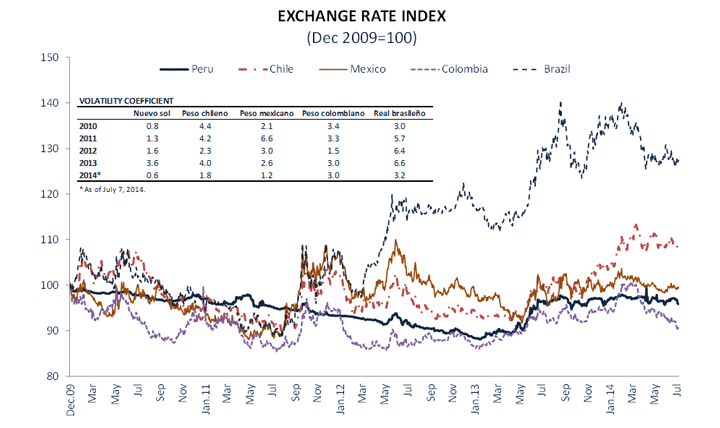
No, on the contrary: the Central Reserve Bank intervenes in the foreign exchange market to reduce excessive volatility in the exchange rate, which can deteriorate economic agents’ balances with currency mismatches and affect their liquidity and solvency.
The graph below shows that the Peruvian currency has registered lower volatility than other currencies in the region, such as the Brazilian real, the Colombian peso, the Chilean peso, and the Mexican peso.
23. Does foreign exchange market intervention seek to set the exchange rate?
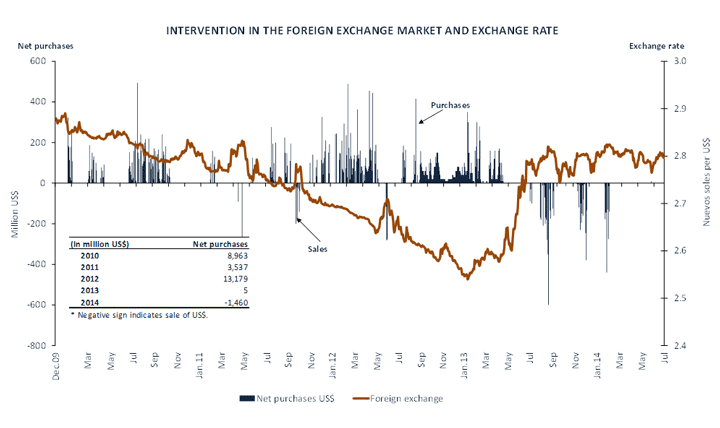
No, foreign exchange interventions only seek to reduce volatility in the exchange rate and not to determine it or affect its tendency, which depends on the fundamentals of the economy.
For example, significant inflows of short-term capital which generated pressures that caused an accelerated fall in the exchange rate were observed in the first four months of 2008. In response to these capital inflows, the Central Bank intervened in the foreign exchange market buying foreign currency for a total of US$ 8.73 billion in order to reduce the volatility of the exchange rate. This intervention also allowed the country to accumulate international reserves and strengthen its international liquidity.
The international financial crisis brought about changes in the portfolio of both resident and non-resident investors who restructured their portfolios and moved to assets perceived as safer assets. Between September 2008 and February 2009, given the greater preference for liquidity in dollars observed, the Central Bank responded by selling foreign currency (FC) for a total of US$ 6.84 billion on the spot market to meet the demand for foreign currency and reduce the volatility of dollar-nuevo sol exchange rate.
Moreover, after this episode, the exchange rate appreciated reflecting the evolution of capital inflows and the portfolio movements of non-resident and institutional investors in emerging markets. In this scenario, the BCRP sought to reduce the extreme volatility in the exchange rate through by purchasing foreign exchange and by raising the rates of reserve requirements. From 2012 to June 2014, the Central Bank’s purchases of FC amounted to US$ 19.07 billion while the sales of FC amounted to US$ 7.35 billion. In net terms, the BCRP purchases of FC were higher by US$ 11.72 billion than the BCRP sales of FC.
24. Has the Central Bank increased or facilitated short-term external financing?
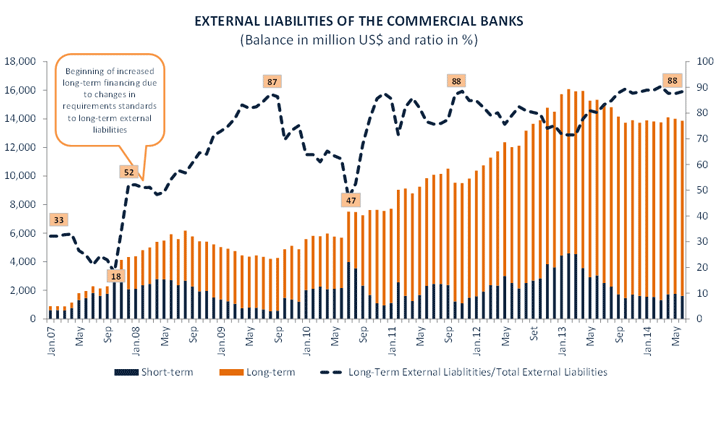
The BCRP has modified its reserve requirement standards as from October 2007 to promote long-term credit from international banks and discourage short term financing, contributing in this way to strengthen the soundness of the country’s financial entities.
As a result of the reserve requirement measures implemented since then, banks’ portfolio of external debt has been restructured and now shows a higher ratio of long-term debt and a lower ratio of short-term debt. As we can see in the figure below, 18 percent of external bank credit lines were long-term loans in October 2007. At June 2014, this ratio has increased to 88 percent.